Conversations in BSL require a back-and-forth interaction, where each person takes their turn. If someone doesn’t take their turn, the conversation can stall. In formal assessments, students are expected to ensure their conversations are not too one-sided. In everyday conversations too, a one-sided conversation won’t feel like a genuine exchange.
Taking your turn in a conversation can’t always be reduced to a series of questions and answers either. Conversations in any language have a natural fluidity to them. There will be interruptions, follow-up questions and occasional clarifications.
When to take your turn
Knowing when it is your turn to sign in a BSL conversation can feel tricky to explain at first, however as you practice you’ll develop an intuition for it – you probably don’t actively over-think about when to take your turn in an English conversation!
Look for visual clues, especially those from the eyes and eyebrows. Eye gaze is important in BSL due to the visual nature of the language and if someone is looking at you without signing, that’s probably your cue to sign. Raised eyebrows is another tell-tale sign that it is your turn to respond.
In BSL (and other sign languages), signers tend to slow or hold their last sign, moving their hands to a resting position to indicate they have finished their turn. This is another clue to look for so you can respond appropriately.
Keep the conversation flowing
To avoid a conversation feeling like a Q&A session, think about incorporating some of the following signs and techniques into your conversations.
You can show engagement without interrupting the other signer’s flow by using some of these signs.



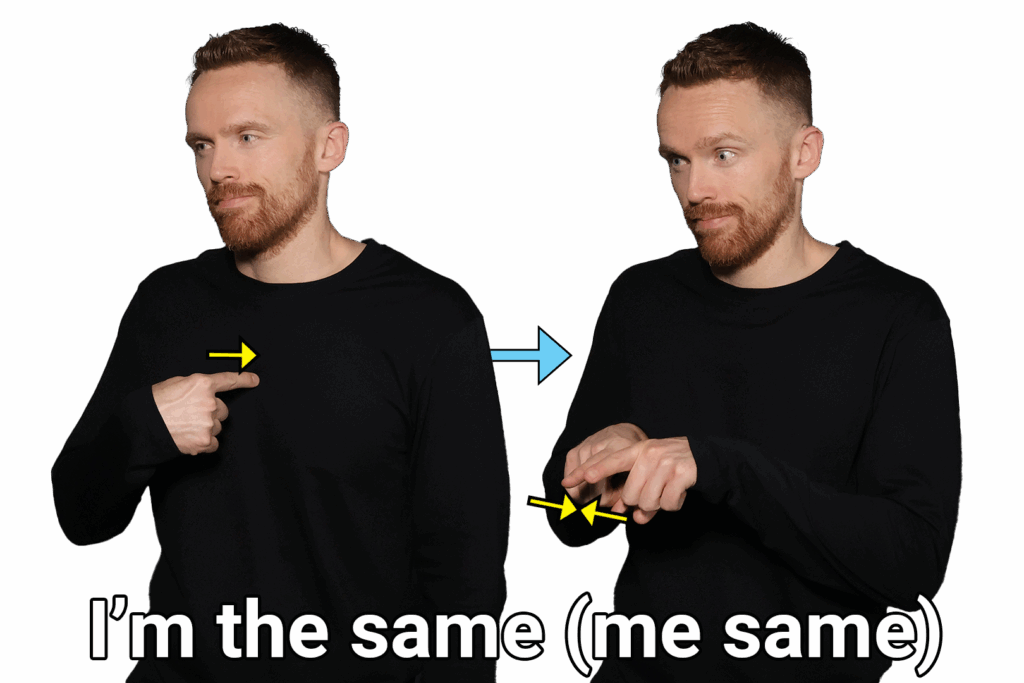
Interruptions in conversations happen naturally. For example, if someone is signing about their love for coffee, you might interject with I’m the same which is signed ME SAME.
Repeating information to show you understand is a key skill and in BSL exams, it’s a requirement. Repeating information back is an excellent way to demonstrate your comprehension. If someone fingerspells something to you, try repeating what they have fingerspelled.
Exercise: With a partner, try to have a natural conversation about a topic covered in the Core Vocabulary section. Try to avoid a Q&A style conversation and instead focus on the flow of the conversation. This is one of the more tricky aspects to practice and you’ll find the more you learn, the more natural this will become. An example conversation is below (in BSL sign order).
Signer 1: Subject my favourite English
Signer 2: Me same, science I don’t like
Signer 1: Really? Science I love.
Signer 2: Now me learning French, beautiful language.
Signer 1: I agree.
Key points to remember
1. Try to ensure your BSL conversations are not too one-sided.
2. Watch out for visual clues to indicate when it is your turn to sign, such as eye gaze, raised eyebrows or a signer holding their last sign.
3. Keep the conversation flowing by showing engagement in what the other person is signing.
Useful downloads and links
A PDF version of this page will be available to download soon.